
Tag Archives: recipe
Ricette Italiane ~ By Leelee
ARROSTICINI
You may have read some time ago when the Guys were in Abruzzo at Gianluca’s home and they were having a local dish called Arrosticini. Then, most recently, there was our Ignazio dueling with skewers of Arrosticini.

So I thought I would write about this local fare.
Pronounced phonetically as Ah-ro (long o and don’t forget to roll your “r’s”)-sti-chee-nee, they are little cini’s that are roasted. (JUST KIDDING).
From Wikipedia:
Arrosticini are a traditional dish from the region of Abruzzo. Arrosticini (rustelle or arrustelle in the local dialects; also known as spierini or spidducc’) are typically made from castrated (I’m not going there!) sheep’s meat (mutton), cut in chunks and pierced by a skewer. It is cooked on a brazier with a typically elongated shape, called canala as it resembles a gutter.

There are two main kinds of arrosticini: those made industrially, consisting of cubical chunks of meat with a side of 1 cm (1/2.5 inches) on skewers with a maximum length of 10 cm (4 inches); and those made by hand, for which the meat is cut with a knife in chunks of different sizes, alternated on the skewer with pieces of ovine fat (doing so provides more tenderness and a more pleasant smell). This kind of arrosticini requires meat of very high quality because it has to be cooked for a longer time.
Arrosticini originate from the food consumed by shepherds and other inhabitants of the mountainous areas in Abruzzo within the villages of Civitella Casanova, Carpineto, and Villa Celiera, who were accustomed to eating even less refined food than hard sheep meat.
Arrosticini are often accompanied by slices of traditionally home-made bread soaked in extra-virgin olive oil with large amounts of peperoncino in olio. The traditional beverage accompaniment is Montepulciano d’Abruzzo wine, or — as it is done in some restaurants — a drink consisting of two parts of red wine and one part of gassosa (roughly the Italian equivalent of beverages like Sprite).
Traditionally, arrosticini are eaten with bare hands, pulling the meat off the skewer piece by piece using one’s teeth.
They are produced throughout Abruzzo, both industrially and in a home-made fashion. They are also found in other areas with large populations of Abruzzesi.
Ingredients for 4 people:
2 pounds lamb
pepper to taste
salt to taste
Preparation 30 minutes preparation + 10 minutes cooking
1. Cut the meat into small pieces (about ½ – 1 inch)
2. Thread onto wooden skewers about 10 – 12 inches long
3. Grill skewers over a moderate coal fire to prevent them from drying out
4. Season with salt after cooking
5. The meat goes well with homemade bread brushed with olive oil

~~Leelee
***
Thanks Leelee.
It’s a small world. They’re merely eating shish-kabobs with wine spritzers.
Sounds Yummy! I’m going to try that the very next time Kroger has a sale on castrated sheep’s meat.
Ricette Italiane ~ By Leelee
Finally, a recipe that Leelee can actually make!
I meant to run this recipe on March 19th. Other things got in the way.
~Marie

I had something for Ignazio in January and Gianluca in February, so I thought it was time to do something for Piero. Back in January, Piero posted a picture of what looks like what my family used to make, Zeppola’s (See Piero’s picture below. If they aren’t Zeppola’s, let’s just go with it anyway ?). This is also in honor of St. Joseph’s Day, March 19th.

I remember the wonderful Italian feasts when growing up in New York, the most noted being the San Gennaro feast in Little Italy in downtown Manhattan, which still goes on until today. No Italian feast was without the Zeppola stands (my family pronounced them, mind you this is phonetically, as Tsay-po-lah). Boy that looks funny.
What is a Zeppola?
From Wikipedia: A Zeppola (plural: zeppole; in southern Italian dialects: zeppoli) is an Italian pastry consisting of a deep-fried dough ball of varying size but typically about 4 inches (10 cm) in diameter. This doughnut or fritter is usually topped with powdered sugar, and may be filled with custard, jelly, cannoli-style pastry cream or a butter-and-honey mixture. The consistency ranges from light and puffy, to bread- or pasta-like.
Zeppole are typical of Italian cuisine, especially that of Rome and Naples. They are also served in Sicily, Sardinia, on the island of Malta, and in Italian-American communities in the United States. Zeppole are known by other names, including Bignè di San Giuseppe (in Rome), St. Joseph’s Day cake, and sfinge.[1] Zeppole are traditionally consumed during the Festa di San Giuseppe (Saint Joseph’s Day) celebrated every March 19, when zeppole are sold on many streets and sometimes presented as gifts.
The custom was popularized in the early 19th century by Neapolitan baker Pasquale Pintauro.
There are many versions of the Zeppole. The St. Joseph traditional version is made with ricotta and eggs. You can find many versions on the internet.
St. Joseph’s Day
The feast day of St. Joseph is celebrated on March 19 every year.
St. Joseph’s Day is a Roman Catholic feast day commemorating the life of St. Joseph, the step-father of Jesus and husband of the Blessed Virgin Mary. People with very strong religious association, often those of southern Italian descent, typically celebrate St. Joseph’s Day. March 19 is said to be St. Joseph’s birthday.
During a famine in Sicily, when food was scarce and many people were starving, the poor people had only their faith to rely on. St. Joseph was known as the protector of the Holy Family and Italians had strong family relationships, so they prayed for St. Joseph to intercede for them so they could have successful crops. Their prayers were answered, and the famine came to an end. In gratitude, people promised to make annual offerings of their most precious possession – food – in St. Joseph’s honor.
Today, the faithful erect “St. Joseph Tables,” which are set to honor St. Joseph. They are filled with beautiful and often elaborate foods, including meatless dishes such as stuffed artichokes, pasta and fish, as well as breads, cookies, pastries, cakes and other delicacies. Each table is blessed by a priest and presided over by a statue of St. Joseph. A stalk of lily blossoms, votive candles and a lace tablecloth are other typical items used to decorate the feast table.
When you visit a St. Joseph’s table, you often receive gifts of fava beans and breads. Fava beans play an integral part of the celebration because this was the food that saved the Sicilians from starvation. The bean is said to bring good luck, and it is believed that if the St. Joseph’s bread is kept in the home, the family will never starve
***
Now for the recipe. This is the way my Mom used to make them. Now this is really complicated so get ready!!!
You can make these easily at home using pre-made pizza dough.
Heat a pot of oil to 375 degrees. Tear off 2 to 3 inch pieces of dough and carefully place them in the oil. Carefully turn them while frying. They will quickly brown and rise to the top. When they do remove them and drain. The Italian feasts usually shake the pieces in a paper bag with powdered sugar but my Mom just drizzled some honey over them.
THAT’S IT! MANGIA!
Maccheroni alla Chitarra al Pomodoro Piccante “Guitar Pasta” with Spicy Tomato Sauce by Alicia
Another yummy Italian recipe and a little history from Alicia (Leelee). She may be a bit confused though. Leelee, you eat pasta and strum a guitar, honey.
***
In honor of that special someone’s birthday this month (I wonder who?), I tried to find recipes from Montepagano, but because Montepagano is so small, I broadened the horizons to find foods from Abruzzo. I found the following website very informative.
–
http://www.rusticocooking.com/abruzzo.htm
ABRUZZO

“Abruzzo is one of Italy’s little-known treasures: a tranquil mingling of mountains and coastline, it is sparsely populated and rarely visited by tourists. Home to one of Italy’s highest peaks (the Gran Sasso, at an altitude of over 9,500 feet) and a busy port (Pescara, the most populous city in the region), it boasts a rich repertoire of robust mountain dishes and an abundance of seafood specialties. The regional capital is L’Aquila, a charming city with a view of the Gran Sasso that was founded by Frederick II of Swabia in 1254; today, L’Aquila is home to 70,000 people. Near L’Aquila is the Parco Nazionale dell’Abruzzo, an enormous natural reserve (about 200 square miles) where hundreds of rare animal species roam free. Other important Abruzzese cities are Teramo (whose first-century A.D. Roman theater is still used to host shows), Chieti (an ancient Roman settlement), and, from a culinary standpoint, the village of Villa Santa Maria (where some of Italy’s finest chefs honed the art of Italian cuisine). “
“Pasta is the preferred Abruzzese first course, and none is as typical as maccheroni alla chitarra (“guitar pasta”): sheets of egg dough are cut using a flat rolling pin on a wooden box with strings (hence the name “guitar”).”
I chose this recipe as it seems to be the preferred method of making pasta for the region. For those who are brave and wish to make this from scratch, then this recipe is for you. However, for those of us (ok – me), who don’t cook or cook often, I’m sure there are some shortcuts that can be improvised in place of making handmade pasta. Ronzoni comes to mind (I know, not the same, but what the heck!).
Maccheroni alla Chitarra al Pomodoro Piccante
“Guitar Pasta” with Spicy Tomato Sauce

Abruzzo is queen of handmade noodles. Pastas include fettuccine sauced with onion, parsley, basil, and Pecorino; spaghetti with garlic and chili, as in Molise; and vermicelli in a saffrony sauce infused with zucchini blossoms. Maccheroni alla chitarra, the region’s proudest pasta, derive their name from the instrument (a wooden frame on which parallel strings are mounted) used to cut the pasta. Fresh maccheroni alla chitarra have a rough texture that grabs onto sauce splendidly; if you don’t have a “guitar,” use 1/2 pound of dried maccheroni alla chitarra instead. For this recipe, you will need:

For the sauce:
2 tablespoons extra-virgin olive oil
2 garlic cloves, minced
24 basil leaves, thinly sliced
1 fresh chili pepper, minced, or 1/2 teaspoon chili flakes
1/2 pound fresh grape or cherry tomatoes, diced
1/2 teaspoon salt
1/4 teaspoon freshly ground black pepper
For the pasta:
1 and 1/2 cups semolina flour, plus extra as needed
2 large eggs
To cook and serve:
2 tablespoons salt
2 tablespoons extra-virgin olive oil
1/2 cup freshly grated Pecorino Romano (optional)

Step 1
Make the sauce: Place the olive oil, garlic, basil, and chili in a wide skillet.
Turn on the flame and allow the aromatic ingredients to warm gently for about 1 minute. It is essential that they release their aroma into the olive oil without burning. This is best achieved by starting the aromatics in cold oil and warming the oil along with the aromatics, rather than adding the aromatics to hot oil as most recipes indicate.
Step 2

Using a wooden spoon, stir well and add the tomatoes to the skillet.
Season the tomatoes with the salt and pepper. Bring to a gentle boil over a medium-high flame, then cover with a tight-fitting lid.
Cook without uncovering the skillet for about 5 minutes, shaking the skillet every minute or so. The tomatoes will break down into a nice, chunky sauce. Once the liquid surrounding the tomatoes takes on a warm orange hue, the sauce is ready and the flame should be turned off. This sauce tastes best if cooked quickly, not simmered a long time.
Step 3

The raw ingredients for homemade maccheroni alla chitarra are simple: just semolina flour and eggs. The standard formula used by most Abruzzese cooks is 3 and 1/2 ounces of semolina flour in all per egg. If you like your pasta less rich, you can replace 1 of the eggs with tepid water.
Make the dough: Place the semolina flour on a counter. Make a well in the center and crack the eggs right into the well.
Step 4

You can use a fork to beat the eggs if you like, or simply use your fingertips like I do to mix the eggs into a nice frothy mess.
Then start drawing in the flour from the edges of the well, little by little, until the eggs become a thick slurry. It will be a bit messy and may seem sticky at first, but as you draw in more flour, the dough will start to come together and form a shaggy mass. It will gather around your hands.
When almost all of the flour has been incorporated into the eggs, begin kneading the dough by hand. The goal is to incorporate all the flour into the eggs, so don’t stop just when it seems the dough has come together; remember, this has to be a firm dough, so if it is sticky, it will be a problem later on.
Step 5

Begin to knead the dough with the palms and heels of your hands.
If the dough is dry, add a touch of water; if it is moist, add a touch of flour.
Alternately, place the semolina flour in a bowl, make a well in the center, and add the eggs to the well. Work the eggs into the flour in the bowl, then turn the resulting dough out onto the counter and knead it as above; this method may be easier for beginners.
Use a dough scraper (sometimes called a bench scraper) to scrape up any flour or egg that is stuck to the counter. (You can buy this handy tool at any good kitchenware shop or baking supply store; it makes cleaning up after working dough a snap.)
Incorporate these bits into the dough while the dough is still in its initial stages; if you wait too long to incorporate these drier or shaggy bits, and you add them to a nearly finished dough, they will ruin the smooth texture you have already achieved in your dough.
Knead the dough until it is smooth and supple with your hands; it will take about 5 to 10 minutes.
Use all the strength you have in your hands; this is a rather firm dough, nothing like bread dough; it is quite dry, and needs to be pushed, compressed, turned so that the flour absorbs the eggs and the resulting dough becomes smooth and supple.
The aim of kneading the dough is not to develop the gluten in the dough, as in bread-making, but rather to produce a dough that is homogenous and workable. This will take a few minutes of vigorous kneading.
Step 6

Now it is time to let the dough rest about 30 minutes so the gluten relaxes and the dough is easier to roll out. Cover the dough with plastic wrap or with a clean, dry towel, and let it sit at room temperature for 30 minutes.
Once the dough has rested, lightly sprinkle a counter with semolina flour and start rolling the dough out into a thin rectangle with a rolling pin.
If you have a long wooden dowel, or thin, tapering rolling pin, this will be easier. But even a regular rolling pin works.
Step 7

Try to keep the dough rectangular as you roll it out. The length should be slightly shorter than the stringed portion of the guitar. The total thickness should be about 1/4 of an inch.
In essence, maccheroni alla chitarra are square spaghetti; so they should be as thick as the strings are wide. Since most guitars have 2 settings, select the setting you prefer and roll out the dough into a rectangle of that thickness.
Step 8

Cut the dough with a pastry wheel into rectangles similar to the stringed portion of the guitar.
It is much easier for the guitar to cut the dough into strands when the dough has had a chance to dry out a bit at room temperature. The metal of the guitar cuts better through a slightly dry dough than through a dough that is still rather moist. So let the dough rectangles sit about 15 minutes before cutting on the guitar.

One by one, place the dough rectangles on the stringed portion of the guitar.
Place the rolling pin on the bottom-most portion of dough and roll with all your strength up, towards the top. The dough should cut into nice, even strands. Ideally, you will only need to roll upwards once if the guitar strings are really sharp.
If the strings do not cut the pasta well, it may be that they need tightening, or that you need to apply more strength on the rolling pin as you roll.
When the pasta is cut, it will look like square spaghetti. Toss with semolina flour and place on a semolina-dusted tray, separating the strands so they do not stick together.
The pasta can be held at room temperature for a few hours or refrigerated for up to 24 hours, as long as you make sure to toss it with semolina flour once in a while to prevent sticking.
Step 9

To cook the pasta: Bring 4 quarts of water to a rolling boil and add the salt.
Add the pasta and stir well to separate the strands. Cook about 3 minutes, or until al dente. This is a thick, toothsome pasta, so it will take longer than most fresh pastas to cook through. In fact, when rolled to the same thickness, all semolina flour pastas take longer to cook though than pastas made with all-purpose flour.
Drain the pasta, reserving 1/2 cup of the pasta cooking water.
Step 10

Toss the pasta with the warm tomato sauce, the olive oil, and the reserved pasta cooking water as needed to dilute to a coating consistency. You may not need all of the reserved pasta cooking water.
Taste and adjust for salt and pepper. Sprinkle with Pecorino if desired and serve hot. Serves 2 hungry people.
Mangiare Bene, Alicia
***
Alicia, then Can you play El Mondo on the guitar while eating?
Ricette Italiane ~ By LeeLee
Coming up with different ideas for The Flight Crew site, I thought it might be fun to have a recipe of the month. So the Board asked me to do it, of which it gives me great pleasure. However, to anyone who knows me, they are laughing hysterically as cooking and my name should never be brought up in the same sentence. I know – what kind of Italian am I that doesn’t cook? Alas, it’s true. My ex-husband used to call me a kitchen tourist (no kidding). However, I do love to eat (trust me it shows).
So how about I come up with recipes for dishes that are either favorites of Piero, Ignazio, and Gianluca, or dishes that come from the areas where they were born or currently reside?
For January, I thought I would start with Ignazio. We all know how much he loves his Mamma’s Italian lasagna dish “Rosette” (not to be confused with the Italian pastry dessert). This is a dish I was not familiar with in my family, so with a little research, I found a recipe taken from the following website: (http://www.mangiabenepasta.com/pasta_roses.html). The only difference is that Ignazio’s mom makes it with white sauce. The comment in the website says that this recipe comes from Modena, Italy. I looked and found that Modena is right outside Bologna. (Bologna – sound familiar??)
Either way, don’t know about you, but this looks and sounds so yummy. ENJOY and Mangia!

Pasta Roses
“Rosette di Pasta”
(Serves 6 to 8 as an appetizer or pasta course)
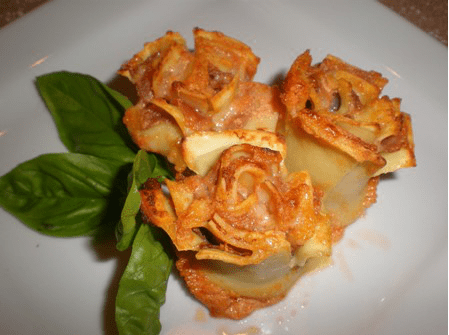
Pasta Roses is a unique pasta dish from the Emilia-Romagna region of Italy. Known as Rosette di Pasta alla Romagnola (or alla Emiliana) they are most commonly found around Modena. The original recipes that I found for pasta roses used ham and fontina cheese. In this recipe I decided to try prosciutto and asiago cheese and really enjoyed that flavor combination. You could also make pasta roses a vegetarian dish by using thin, blanched slices of zucchini and cheese for the filling. Fresh pasta is best for this recipe but you can use dry lasagna pasta if you prefer. Try to find flat lasagna strips without the curly edges. If you use curly-edges lasagna, cook it first and then use a knife or pizza cutter to trim off the edges.
Pasta Roses are a beautiful dish to serve for Mother’s Day, Valentine’s Day, a bridal shower, anniversary, or any other special occasion.
The pasta roses may be assembled ahead of time and refrigerated. Remove them from the refrigerator about 1 hour before you plan on baking them. The pasta should be at room temperature before you put it in the oven.
Ingredients:
1/2 pound fresh egg pasta dough
4 tablespoons unsalted butter
1 cup heavy cream
1 tablespoon tomato paste
1/8 teaspoon grated nutmeg
8 ounces prosciutto, sliced very thin
4 ounces Asiago cheese, shredded
3 tablespoons grated Parmesan cheese
Fresh basil leaves for plating (optional)
Directions:
To roll and cook the dough:
Roll the pasta dough to 1/8-inch thickness. Cut the dough into 8 strips,
4-inches wide x 8-inches long. Cook the pasta strips 2 or 3 at a time in boiling salted water for 10-15 seconds. Transfer the cooked pasta to a bowl of ice water to stop the cooking. Then place the cooled strips on a towel and repeat with the remaining strips.
To make the sauce:
Put butter and cream in a small saucepan over medium heat. Bring the mixture to a simmer and reduce the sauce a bit, about 2-3 minutes. Add the tomato paste and the nutmeg; stir to incorporate. Continue cooking the sauce until it is the consistency of buttermilk, about 2 minutes. Spread half of the sauce in a shallow baking dish that is about 8 x 10-inches. Set the remainder of the sauce aside.
To make the Besciamella (white sauce) with Zucchini Puree (taken from another recipe):
Trim ends off washed zucchini then chop or slice roughly. Bring a small pan of cold water to the boil, salt when the water is boiling and then tip in the zucchini and cook till tender. Strain out and immediately refresh in very cold water. Drain, place in a deep beaker and whizz till smooth using an immersion blender. Set aside.
Place the milk to heat in a small sauce pan while in another pan you cook the butter and flour, whisking them together to make the base.
When the milk comes to the boil take both pans off the heat and pour all the milk at once onto the base, whisking hard with a large whisk to blend the two into a smooth and lump free white sauce. Should lump forms don’t worry, just strain the white sauce through a sieve.
Season with salt or if you prefer with plenty of freshly grated nutmeg and about 20g of grated Parmigiano-Reggiano.
To form the pasta roses:
On each pasta strip, place a slice of prosciutto. Cut the prosciutto to fit; it should not overlap the edges of the pasta. Sprinkle each strip with some of the shredded Asiago cheese. Roll up the pasta like a jelly roll, starting from the short side of the strip. Cut the strips into 2 or 3 pieces that are about 2-inches high. With a paring knife make an X cut about 1/2-inch deep into one side of each piece. These cuts will help the roses “bloom.”
Preheat the oven to 450. Put the roses in the baking dish with the cross cuts face up. Press down a bit on the roses to help them open slightly. Use a pastry brush to brush the remaining sauce over the roses. Sprinkle with Parmesan cheese. Bake for about 15 minutes, or until a light brown crust forms on top. Remove from the oven; let rest for 5 minutes before serving. Place 2 or 3 pasta roses on individual serving plates. Tuck in a few basil leaves as a garnish.
LeeLee
Thank You Leelee. Sounds wonderful and looks beautiful. Someone please make this, freeze it and send it to me. Thanks! ~Marie